Views: 0 Author: Site Editor Publish Time: 2025-11-07 Origin: Site


Hydraulic swing beam shears are essential tools in industrial settings. They cut through various materials with precision using hydraulic power. In this article, we'll explore which materials can be cut with a hydraulic swing beam shear. You'll also learn about factors influencing cutting efficiency and precision.
A hydraulic swing beam shear is a specialized cutting machine that uses a hydraulic system to move the cutting blade in a swinging motion. The blade is mounted on a beam that pivots around a fixed point, allowing it to cut materials with minimal distortion. The hydraulic force applied during operation ensures consistent performance, providing precise and efficient cuts.
This technology is commonly used in the manufacturing, metalworking, and fabrication industries, where high-volume production and clean edges are critical. The hydraulic swing beam shear's ability to handle a range of materials and thicknesses makes it a versatile solution for various applications.
The main features of a hydraulic swing beam shear include:
Oscillating Blade Movement: The swinging motion of the blade ensures smoother cuts and reduces the risk of material distortion.
Hydraulic Power: Hydraulic systems allow for powerful, controlled cuts, ensuring efficiency and precision across various materials.
Adjustable Blade Angles: The angle of the blade can be adjusted for different thicknesses and material types, allowing the shear to handle a wide range of cutting tasks.
One of the key benefits of using a hydraulic swing beam shear is its ability to deliver high-precision cuts. The oscillating motion results in clean edges with minimal burr formation. This quality is particularly valuable in industries that require consistent cutting performance, such as aerospace, automotive, and construction. Furthermore, hydraulic shears are capable of cutting materials at a high rate, making them suitable for large-scale production environments.
Aluminum is a widely used material across many industries due to its lightweight, corrosion-resistant, and conductive properties. Hydraulic swing beam shears are particularly effective at cutting aluminum, with thicknesses typically ranging from 0.5mm to 20mm. This makes them ideal for applications in aerospace, automotive, and construction.
Applications:
Aerospace: Lightweight components for aircraft bodies and structures.
Construction: Aluminum sheets for framing and cladding.
Automotive: Parts for lightweight vehicles and performance components.
Brass, an alloy of copper and zinc, is often used in applications that require corrosion resistance, such as plumbing, electrical systems, and decorative items. Copper, known for its excellent thermal and electrical conductivity, is commonly used in wire production and industrial equipment. Hydraulic swing beam shears are well-suited to cutting these materials, but it is important to use sharp blades and slower cutting speeds to prevent surface damage.
Cutting Range:
Brass: Typically between 0.5mm and 10mm thick.
Copper: Generally between 0.5mm and 8mm thick.
Stainless steel is prized for its strength and corrosion resistance, making it a popular choice in the food processing, automotive, and construction industries. However, cutting stainless steel with a hydraulic swing beam shear requires attention to blade sharpness and cutting speed. The thickness of stainless steel that can be cut typically ranges from 0.5mm to 16mm.
Applications:
Food Processing: Stainless steel equipment and machinery.
Automotive: Exhaust systems, chassis, and body panels.
Construction: Structural components and decorative finishes.
Mild steel, known for its strength and cost-effectiveness, is one of the most commonly used materials in the manufacturing and construction industries. Hydraulic swing beam shears can efficiently cut mild steel up to 25mm thick, making them an essential tool for high-volume production in industries such as construction, heavy machinery, and infrastructure.
Applications:
Construction: Steel frames, beams, and columns.
Heavy Machinery: Parts for industrial machinery and equipment.
While hydraulic swing beam shears are primarily designed for cutting metals, they can also handle non-metallic materials such as rubber and plastic. These materials are softer than metals, which means that special care must be taken to maintain sharp blades and avoid material deformation. The shear's blade clearance and cutting speed must be adjusted to ensure a clean, precise cut.
Rubber: Used in seals, gaskets, and protective components.
Plastic: Common in packaging, electrical housings, and automotive parts.
Some composite materials, such as fiberglass sheets, may also be cut with hydraulic swing beam shears. However, these materials require special attention to blade maintenance due to their fibrous nature, which can quickly dull the blade.
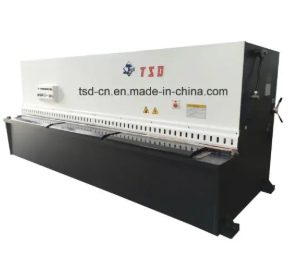
Hardened steel, due to its heat-treated properties, is much tougher and more durable than regular steel. While hydraulic swing beam shears can handle many types of steel, hardened steel poses significant challenges. It requires highly specialized blades, and the cutting speed must be slower to avoid damaging both the material and the shear.
Challenges:
Blade Dulling: Harder materials can cause rapid blade wear.
Potential for Cracking: Improper cutting speeds can lead to cracks or chips in the material.
Titanium, known for its high strength-to-weight ratio and excellent corrosion resistance, can also be cut using a hydraulic swing beam shear. However, due to its toughness, it requires sharp blades and slower cutting speeds to avoid damaging the material. The same challenges apply to other high-strength materials, such as tool steel and alloys used in aerospace and medical applications.
Challenges:
Slow Cutting Speeds: To maintain surface quality, cutting titanium requires slower speeds.
Specialized Equipment: Machines must be equipped with high-quality blades and a powerful hydraulic system to effectively cut titanium.
The type and sharpness of the blade play a critical role in the shear's ability to cut various materials. For softer metals like aluminum, less sharp blades may suffice, but for tougher materials like stainless steel or titanium, sharper blades are necessary to maintain cutting precision.
The hydraulic pressure applied during cutting determines the shear force used to cut the material. Higher pressure is required for thicker materials or tougher metals. The shear's capacity will dictate the maximum thickness and type of material that can be cut effectively.
Cutting speed affects both the quality of the cut and the overall efficiency of the process. Slower speeds are often necessary for harder materials to ensure that the cut remains clean and precise. Faster speeds are suitable for softer materials but can result in increased wear on the blades.
Hydraulic swing beam shears are versatile tools that can cut a wide variety of materials. These include metals like aluminum, copper, and stainless steel, as well as softer materials such as rubber and plastic. However, harder materials like titanium and hardened steel require specialized blades and slower cutting speeds.
By understanding the materials that can be cut and the factors affecting cutting ability, manufacturers can optimize operations for clean, precise cuts. TSD offers reliable Hydraulic Swing Beam Shears that deliver value with excellent performance and precision. Their products ensure efficient and accurate cutting, supporting a wide range of industrial applications.
A: A Hydraulic Swing Beam Shear is used to cut a variety of materials, including metals like aluminum, brass, and stainless steel, as well as plastics and rubber, with precision.
A: It can cut materials like aluminum, copper, mild steel, stainless steel, and plastics. It's ideal for metals in thicknesses ranging from 0.5mm to 25mm, depending on the material.
A: Cutting hardened steel with a Hydraulic Swing Beam Shear can be challenging. Specialized blades and slower cutting speeds are required to achieve clean cuts without damaging the shear.