Views: 0 Author: Site Editor Publish Time: 2025-11-12 Origin: Site


Large press brakes are essential in metal fabrication, offering unmatched bending capabilities for large, thick materials. These machines bring major benefits to industries like construction and aerospace. In this article, we will explore how a large press brake boosts productivity, improves part quality, and enhances overall operational efficiency.
Large press brakes significantly improve productivity by enabling efficient processing of heavy and thick materials. These machines are capable of bending large sheets of metal without the need for multiple passes or pre-heating, which saves time and reduces energy consumption. For example, a 10-meter long press brake can form an entire structural beam in one operation, unlike smaller machines that require several repositioning steps. Consider the material thickness and size of your parts to maximize the benefits of a large press brake in your production process.
One of the most significant advantages of large press brakes is their extended bed lengths. This feature allows manufacturers to process larger workpieces in a single setup. Unlike standard press brakes, which require multiple setups for larger components, large press brakes can handle these parts efficiently, reducing the need for repositioning and thus minimizing potential errors.
The superior tonnage capacity of large press brakes enables manufacturers to process more parts with fewer machine cycles. As a result, high-volume operations benefit from faster cycle times and higher throughput, making large press brakes invaluable in industries where speed is essential.
By reducing the number of times materials need to be repositioned, large press brakes minimize material handling. This not only saves time but also reduces the risk of part damage and improves overall safety in the workplace. Streamlining material handling with a large press brake reduces unnecessary labor and improves overall efficiency, leading to cost savings.
Large press brakes are equipped with advanced controls that ensure high precision, even when bending thick or difficult materials. Their ability to maintain tight tolerances is essential for creating complex parts, especially in industries such as aerospace, where dimensional accuracy is critical.
The rigidity of large press brakes ensures minimal deflection under load, leading to consistent results across large components. This uniformity is vital for structural applications, where dimensional accuracy directly affects the integrity of the final product. Invest in high-precision tooling for large press brakes to achieve the best results for intricate, high-tolerance parts.
Modern large press brakes are equipped with CNC (Computer Numerical Control) systems, which automatically adjust for material springback. This technology reduces human error and ensures that bends are made accurately, regardless of the material's thickness or properties. As a result, manufacturers can achieve higher consistency and fewer defects in their products.
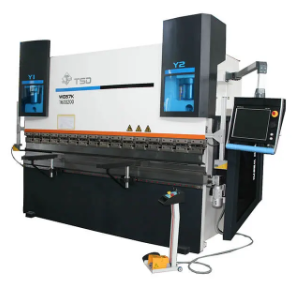
Large press brakes often come with automation features that boost efficiency and reduce labor costs. By incorporating robotics and automated material handling systems, businesses can further increase productivity while maintaining high levels of precision. This automation helps to speed up processes, reduce human error, and allow operators to focus on more value-added tasks.
Although large press brakes come with a higher upfront cost, they can deliver significant long-term savings. By reducing the need for multiple machines and manual labor, large press brakes streamline production and reduce operational costs. Their ability to perform multiple tasks, such as bending, punching, and shearing, consolidates operations, freeing up valuable floor space and labor. Calculate the total cost of ownership (TCO) when investing in a large press brake to ensure that the long-term savings justify the initial investment.
For heavy fabrication operations, large press brakes provide an excellent return on investment (ROI). They enable manufacturers to take on larger projects with greater precision and speed, which increases their competitive advantage in specialized markets. The versatility of large press brakes also opens up opportunities to bid on high-value projects that would otherwise be impossible to complete on smaller machines.
Large press brakes are indispensable in the construction and shipbuilding industries, where oversized components are often required. For example, these machines can bend massive steel beams used in infrastructure projects or ship hull sections. The ability to bend large sheets of metal with precision reduces the need for welding multiple pieces together, resulting in stronger and more reliable parts.
In the energy sector, large press brakes are used to form heavy-duty components like power transmission poles and towers. These parts must meet strict standards for both strength and dimensional accuracy, making large press brakes the ideal solution for manufacturers in this field.
Aerospace manufacturing requires extremely high precision, which large press brakes can provide. These machines are essential for fabricating complex parts with tight tolerances, such as aircraft components, which must meet stringent safety and quality standards. Large press brakes are ideal for industries with complex, high-precision needs, such as aerospace and energy production.
Although large press brakes require significant floor space, they can actually optimize workshop layout by consolidating multiple machines into one. By replacing several smaller machines, a single large press brake frees up valuable space for other critical operations. This not only improves space utilization but also enhances workflow efficiency.
A large press brake can serve as the central hub for the production process, with material flowing from cutting operations directly to the press brake. This streamlined workflow eliminates redundant handling and storage, reducing production time and the potential for material damage during transport.
Investing in a large press brake requires thoughtful planning of your workshop layout. By dedicating space to this machine, manufacturers can create a more efficient production flow, reducing downtime and optimizing throughput. Over time, the space allocated to the press brake will pay off through increased efficiency and fewer workarounds. Plan your workshop layout around the capabilities of the large press brake to maximize operational efficiency and minimize unnecessary handling.
Large press brakes offer numerous benefits, from enhancing productivity to improving part quality. By consolidating operations, increasing throughput, and delivering precise results, these machines help manufacturers stay competitive in industries requiring heavy-gauge materials and large components. While the initial investment may be significant, the long-term savings in labor, material handling, and operational costs make large press brakes a valuable asset for businesses seeking efficiency and precision in their manufacturing processes.
Investing in a large press brake is more than just an equipment upgrade; it's a strategic decision that can streamline operations, boost product quality, and ultimately enhance a company's bottom line. By understanding the benefits of a large press brake, manufacturers can make informed decisions that support both short-term and long-term growth. When choosing a large press brake, consider both your immediate production needs and long-term goals to ensure that the investment aligns with your company's growth trajectory.
TSD offers advanced press brake solutions that enhance manufacturing productivity and part quality. With state-of-the-art features and robust design, TSD's products provide substantial value for businesses seeking precision and efficiency.
A: A Large Press Brake is a machine used in metal fabrication to bend heavy sheets and plates with high precision. It features extended bed lengths and high tonnage capacities, making it ideal for forming large, thick materials.
A: Large press brakes enhance productivity by processing oversized components in a single setup, reducing setup times and material handling. This leads to faster production and lower labor costs.
A: Investing in a large press brake offers long-term savings by improving operational efficiency, product quality, and reducing the need for multiple machines, making it a valuable asset for businesses.