Views: 0 Author: Site Editor Publish Time: 2025-10-24 Origin: Site


Choosing the right press for your needs is crucial for ensuring efficiency and precision in your operations. In this comparison, we'll break down the key differences between the Arbor Press and Air Press, discussing their advantages, limitations, and ideal applications. This will help you determine which press type suits your business requirements. We will also incorporate insights on Hydraulic Press for a broader perspective.
When deciding between an Arbor Press and an Air Press, it's essential to consider their functionality, cost, and performance in your specific application. While both presses serve to apply force, they each have distinct methods of operation and are suited for different tasks. In this article, we'll provide an in-depth comparison of the two press types, highlighting their pros and cons.
An Arbor Press is a manually operated machine that uses gears to multiply force, making it suitable for smaller jobs that require precision. Typically, it applies up to 2 tons of force, making it ideal for tasks like riveting, staking or punching. Due to its simplicity, it requires minimal setup and is commonly used in smaller shops or environments where space is limited.
An Air Press (or pneumatic press) operates using compressed air to exert force. It can deliver up to 2.5 tons of force, making it versatile for various applications such as assembly, swaging, forming and pressing. Air Presses are more complex than Arbor Presses, offering features like adjustable force and enhanced control, often equipped with modern safety measures.
The fundamental difference lies in the operation method: the Arbor Press relies on manual force through gears, while the Air Press uses pneumatic systems. While the Arbor Press is easy to use and low-cost, the Air Press offers more precision and versatility with adjustable force settings.
One of the standout advantages of the Arbor Press is its compact design. Ideal for businesses with limited space, it can easily fit on a workbench without the need for dedicated floor space. Its simplicity also makes it a cost-effective solution.
The Arbor Press is incredibly straightforward to use. There's no need for advanced training to operate it, which is a big advantage in environments with high employee turnover. Just apply force using the lever, and the gear mechanism does the rest.
Due to its minimalistic design, the Arbor Press is typically more affordable than other presses. This makes it ideal for businesses looking for a low-cost solution that offers a good return on investment for tasks like riveting, stamping, and bending. For small-scale businesses or startups, the Arbor Press provides a great balance of performance and cost-effectiveness.
Air Presses are highly versatile due to their adjustable force mechanism. The force can be fine-tuned depending on the application, providing flexibility in various industries like automotive, electronics and food processing.
Unlike the manual Arbor Press, the Air Press often comes with advanced features such as automatic cycle control, safety features and increased precision. These features allow for more consistent results, reducing the likelihood of errors and defects.
Air Presses are easier to maintain compared to other presses like hydraulic models. Since they don't require lubricants or oils, maintenance costs are generally lower. Regular air line checks and simple cleaning are sufficient to keep the press in good condition.
The Arbor Press is limited in the amount of force it can exert, typically ranging from 1 ton to 2 tons. This makes it unsuitable for heavy-duty applications where higher force is needed.
Because the Arbor Press is manually operated, it can lead to inconsistencies in results, especially for tasks requiring precise force. Additionally, the manual operation can lead to repetitive stress injuries, particularly in environments with high-volume tasks.
While the Arbor Press excels at small tasks, it struggles with larger workpieces or more complex applications. This limits its effectiveness for businesses with diverse production needs.
If your business requires high-force applications or precise control, a Hydraulic Press might be a better solution than an Arbor Press.
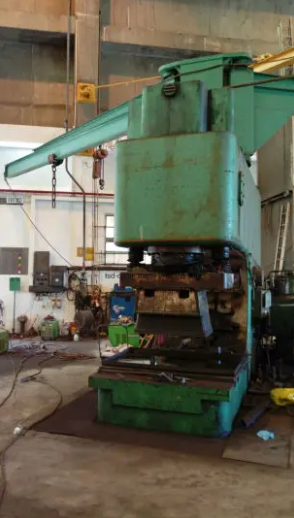
To operate an Air Press, you'll need a reliable compressed air system. If your facility isn't set up for this, you may face additional costs to install an air supply system.
While Air Presses are versatile, their force output is still limited compared to Hydraulic Presses. For applications requiring extreme force (hundreds of tons), the Hydraulic Press is the more suitable choice.
Air Presses tend to generate significant noise due to their air exhaust systems, which can be an issue in noise-sensitive environments. Moreover, air quality can affect the press's performance, requiring regular air purification.
Arbor Presses are ideal for small-scale, precision tasks such as riveting, punched holes, or bearing installation. Their simplicity makes them perfect for tasks that don't require a lot of force but need high accuracy.
In contrast, Air Presses excel in high-volume operations that require both force and flexibility. They are commonly used for assembly lines, swaging, and material forming, where consistent, adjustable force is crucial.
Air Presses can operate at faster speeds with adjustable pressures, making them better suited for fast-paced environments. Arbor Presses, while slower, offer better precision in low-force tasks.
The Arbor Press typically has a lower upfront cost compared to an Air Press. However, the running costs of an Air Press are slightly higher due to the need for an air supply system and ongoing maintenance.
While the Arbor Press requires minimal maintenance, the Air Press needs periodic checks for the air system and regular cleaning to maintain peak performance.
For smaller operations with limited budgets, the Arbor Press provides a higher ROI in the short term. On the other hand, larger operations with high production volume will benefit from the advanced features and speed of the Air Press.
The Arbor Press and Air Press each offer unique benefits depending on your specific needs. The Arbor Press is great for small-scale, low-force applications, while the Air Press excels in high-volume, versatile operations that require adjustable force. However, for heavy-duty tasks requiring higher force, a Hydraulic Press may be the better solution. Understanding the limitations and advantages of each press can help you make a more informed decision based on your production requirements. Before making a purchase, assess your workload, space constraints, and required force to determine whether an Arbor Press, Air Press, or Hydraulic Press is the better fit for your needs. Contact TSD for expert guidance on selecting the right press for your operations.
A: An Arbor Press is a manual press ideal for small tasks requiring up to 2 tons of force. An Air Press uses compressed air for adjustable force, making it better for versatile, high-volume applications.
A: Use an Arbor Press for precision tasks like riveting or punching. If you need adjustable force and higher volume, an Air Press is a better fit.
A: A Hydraulic Press provides much higher force than both the Arbor Press and Air Press, ideal for heavy-duty applications requiring hundreds of tons of force.